
⌂ → Об искусствеПыль, которая помнит всё: почему на картинах старых мастеров предметы всегда покрыты невидимым (или явным) слоем вечности
When you lean close to a 17th-century Dutch still life, the first thing you notice is often the wrong thing. You see the sheen of a silver goblet, the crisp edge of a folded linen napkin, the vibrant red of a peeled lemon. But if you shift your gaze to the heavy folio resting on the table’s edge, you spot it: a faint, grayish film along the top edge of the pages, a thin layer of dust that no one bothered to wipe away.
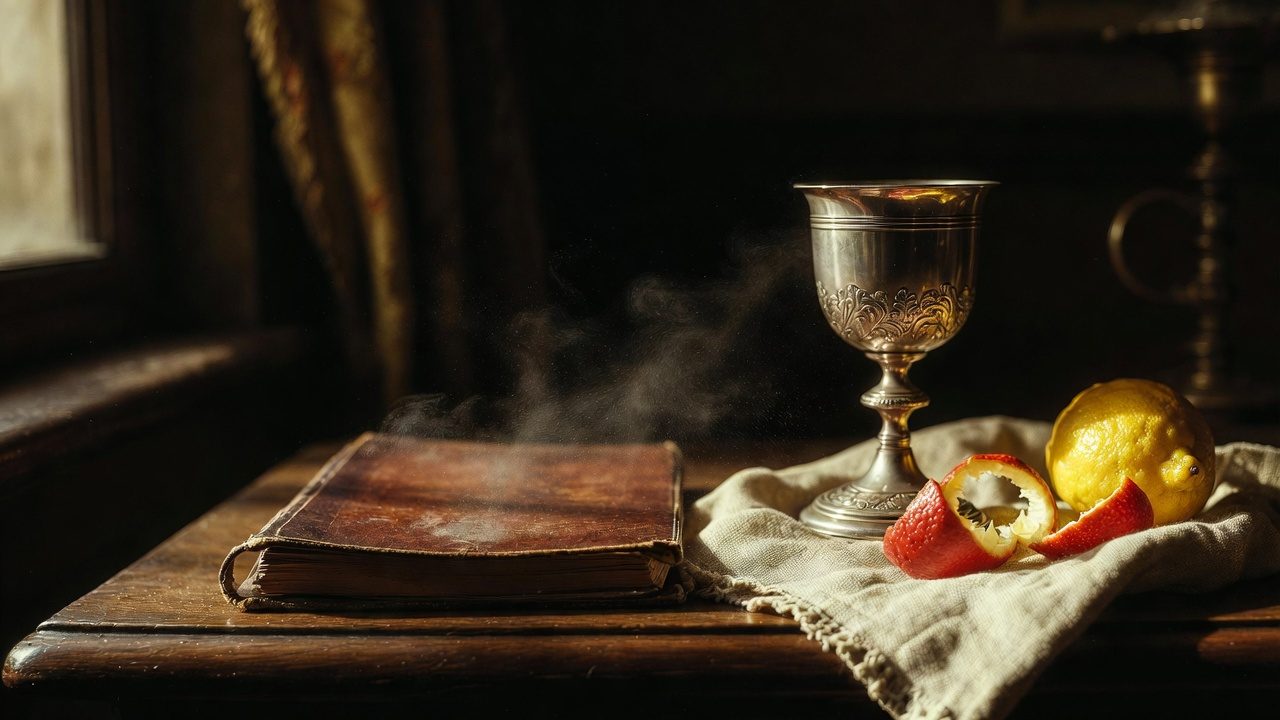
This tiny detail is not a mistake. Old masters did not forget to clean their painted surfaces. They spent hours mixing pigments to match the exact shade of dried debris on a leather-bound book, or the way dust settles in the creases of a velvet curtain. For them, that gray film was never just dirt. It was a deliberate choice, tied to a philosophical tradition that shaped how Europeans viewed time, death, and the value of material goods for centuries.
Слой, который не стирают
The term vanitas refers to a genre of art popular in the Low Countries during the 1600s. These works center on the idea that all earthly possessions, achievements, and pleasures are fleeting. A skull, an hourglass, a wilted flower — each object signals that life ends, and material things lose their worth once their owner is gone.
Dust fits into this tradition perfectly. Unlike a skull, which is an obvious symbol of death, dust is mundane. It builds up on objects no one uses, on books no one reads, on tables where no one sits for months. When a painter adds a dusting of gray to a closed book, they are not showing a messy room. They are showing that the book has sat untouched long enough for debris to settle — long enough that its owner may no longer be alive to open it.
Серый оттенок времени
Willem Kalf’s still lifes feature ornate silver pitchers and expensive Chinese porcelain. Many of these works also show a thin layer of dust on the ledge supporting the objects. The shiny, valuable items stand out against the dull, grimy surface below them — this highlights the gap between temporary wealth and the slow, steady passage of time that affects all things equally.
Scientists have analyzed the pigments used for these dust effects. Most painters used a mix of lead white, charcoal black, and a small amount of yellow ochre to create the grayish tone. The mixture was applied in thin glazes, so the underlying color of the object still shows through. This technique makes the dust look like a natural accumulation, not a painted overlay. It requires patience, but old masters prioritized accuracy for symbolic reasons over speed.
A typical Kalf still life measures roughly 60 by 80 centimeters, small enough to hang in a private home. The dust detail is often no larger than a 5-millimeter streak, but it draws the eye more than the larger, brighter objects nearby.
This attention to dust was not limited to still lifes. Genre paintings, which depict everyday scenes of ordinary people, also feature dust in unexpected places. In Johannes Vermeer’s domestic scenes, dust settles on the wooden beams of the ceiling, barely visible against the dark wood. In Pieter de Hooch’s courtyard scenes, a thin layer of gray covers the top of a stone well, showing it has not been used that day.
Пыль как свидетель
This subtle symbolism appealed to the middle-class buyers who purchased these paintings. They did not want overt moralizing. They wanted art that fit into their homes, that looked like their own lives, but carried a quiet message about how to live. A painting with a dusty book reminded them to read their own religious texts, to not let material goods pile up untouched.
We can see this in the way dust is painted on different surfaces. On rough wood, the dust settles into the grain, so the gray tone is uneven. On smooth marble, it forms a thin, even film that glints slightly in the light. On fabric, it collects in the folds, so the painter adds tiny gray streaks to the creases of a velvet curtain or a linen tablecloth.
| Поверхность | Оттенок пыли | Символическое значение |
|---|---|---|
| Кожаный фолиант | Серый с жёлтым оттенком | Непрочитанные тексты, забытые знания |
| Мраморная полка | Светло-серый, ровный | Временный характер богатства |
| Шерстяная ткань | Темно-серый, в складках | Бездействие, отсутствие владельца |
| Деревянный стол | Неравномерный серый | Ежедневный труд, забытые трапезы |
The consistency of these details across hundreds of paintings shows that dust was not a casual addition. Painters followed a shared visual language that their buyers understood immediately. A housewife seeing a dusty shelf in a genre painting would know it meant the family had been too busy with harvest work to clean, or that a family member was away. A merchant seeing dust on a ledger would think of his own accounts, left untouched while he focused on trade.
Modern viewers often miss these details. We are used to seeing paintings in bright, clean museums, where every surface is lit evenly. We focus on the bright colors, the detailed faces, the expensive objects. The dust fades into the background, just as it does in our own homes. We only notice it when we lean in, when we take the time to look at the parts of the painting no one talks about.
This tradition faded in the 18th century, as art moved toward brighter, more optimistic themes. Rococo painters preferred clean, gilded surfaces, and the vanitas genre fell out of favor. Dust became something to hide, not something to paint. But traces of it remain in the works of later artists, who used grime to show poverty or neglect, rather than philosophical reflection.
Standing in front of a 17th-century still life, lean close to the dark edge of a painted book. The gray film there is not a mistake. It is a message left by a painter who knew that all things fade, and that even dust has a story to tell.