
⌂ → Об искусствеСпина к зрителю: почему художники прошлого редко рисовали героев со спины
When viewers walk through museum halls filled with old master portraits, the vast majority of subjects face forward or turn slightly toward the observer. Full back views of noble sitters are almost nonexistent. Even in genre scenes, characters shown entirely from behind appear only in very specific contexts.
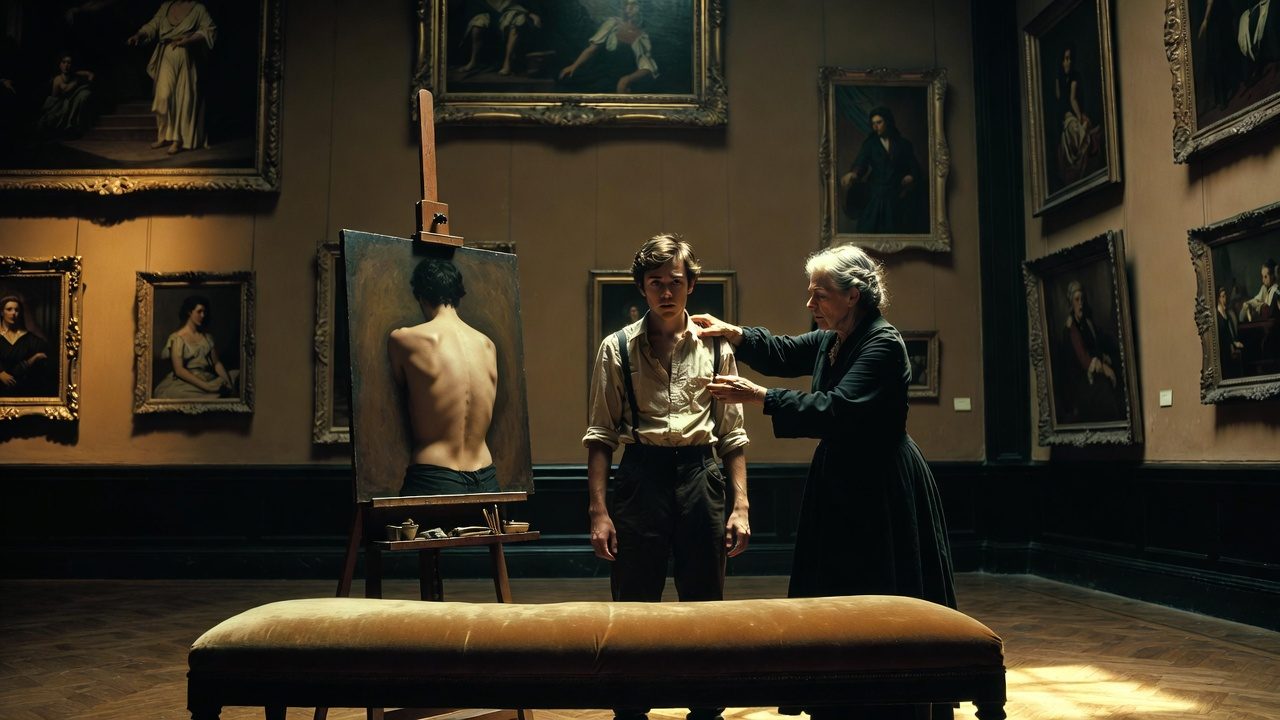
Technical challenges were the first barrier for many artists. Painting a human back accurately is harder than a frontal view. The spine, scapulas, the way muscles tense when arms move — these are subtle, easy to get wrong. A poorly drawn back looks flat, or like the figure is slouching when they aren’t.
Anatomical challenges — especially those related to the spine and shoulder blades — were a common complaint among apprentices in 17th century workshops. Scapular placement alone could take hours of adjustment for a large-scale portrait. Even minor errors would be noticed by critical patrons and fellow artists.
Social norms around posture and propriety played a far larger role than technical skill. In 18th century European courts, turning one’s back to another person was a grave insult, a sign of total disregard. Commissioned portraits were meant to project status, not contempt for the viewer.
Табу на неприличные позы
For aristocratic sitters, the back was tied to ideas of vulnerability and indecency. Exposing the back implied a lack of control, a moment when the subject could not monitor who approached them. Court etiquette required constant awareness of one’s surroundings, especially for high-ranking nobles. A portrait showing a sitter from behind would contradict that core expectation of poise and vigilance.
Religious and moral symbolism added another layer of restriction. In Baroque art, back views were reserved almost exclusively for figures of shame or exclusion. Penitent sinners, exiled wanderers, or spies slinking away from a scene were shown from behind to signal their separation from the observer and the community. Frontal views, by contrast, invited connection and shared moral standing.
This convention was so strong that even when artists painted servants or lower-class figures from behind, it carried a clear class marker. A lord would never be shown with his back to the viewer, but a kitchen maid carrying a tray might be. The pose reinforced social hierarchy as clearly as fine fabric or jewelry did.
Анатомия и оптика
Apprentice painters in old master workshops spent years practicing frontal and three-quarter views before attempting a back study. Master artists would correct these studies, pointing out how the trapezius muscle connects to the neck, or how the lumbar curve changes when a figure leans forward. These details were considered standard for a believable portrait, no matter the pose.
The human back presents practical challenges even for skilled painters. The spine runs straight down the center, but the muscles on either side are rarely perfectly symmetrical. Scapulas shift with every arm movement, and the curve of the ribcage is harder to gauge from the back than the front. A small error in placing the shoulder blades can make a figure look like they have a hunched back or a twisted torso.
| Характеристика | Фасные портреты | Портреты со спины |
|---|---|---|
| Количество в музейных коллекциях | Преобладают (более 90% от всех портретов знати) | Единичные экземпляры |
| Социальный статус сидящего | Любой, даже представители высшей знати | Низшие сословия, изгои, второстепенные персонажи |
| Символическое значение | Открытость, статус, связь с зрителем | Уязвимость, исключение, скрытность |
The imbalance in surviving works is not a coincidence. Patrons explicitly requested poses that showed their faces clearly, often specifying in contracts that the portrait must show the subject’s full face, or at most a slight turn. There are almost no surviving commission contracts that mention a back view as an option.
Взгляд вслед
A less discussed reason for avoiding back views is the way they direct the viewer’s gaze. When a figure faces the observer, the viewer’s attention stays fixed on the painting. When a figure turns away, the viewer’s eye follows them, looking toward the empty space behind the figure on the canvas. This breaks the visual bond between the artwork and the person looking at it.
For portrait painters, whose job was to capture the sitter’s likeness and personality, this loss of connection was a major drawback. A back view gives no insight into the subject’s mood, their expression, or their character. It reduces the sitter to a silhouette, stripping away the very details that made a portrait valuable to its owner.
This rule began to change only in the 19th century, as artistic movements like Realism and Impressionism moved away from strict court conventions. Artists began to paint ordinary people in casual poses, including back views of workers in fields or passengers on trains. Even then, portraits of nobles or wealthy patrons from behind remained rare well into the 20th century.
Even today, back views in portraiture carry a hint of unease. They remind viewers that there is always a part of a person — or a painting — that stays hidden from sight.