
⌂ → Об искусствеТени за главным героем: почему второстепенные персонажи старых мастеров выглядят недописанными
When you stand in front of a 15th-century oil painting, your gaze locks onto the central figure first. A crowned monarch, a kneeling saint, a wealthy merchant donating to a church — their faces are rendered with such precision that individual eyelashes seem visible. Shift your eyes to the edges of the canvas, though, and the people surrounding them shift. A servant holding a tray, a page standing in the corner, a passerby on a distant street has no clear features. Their fingers blend into a single pale mass, their postures stiff, their expressions blank.
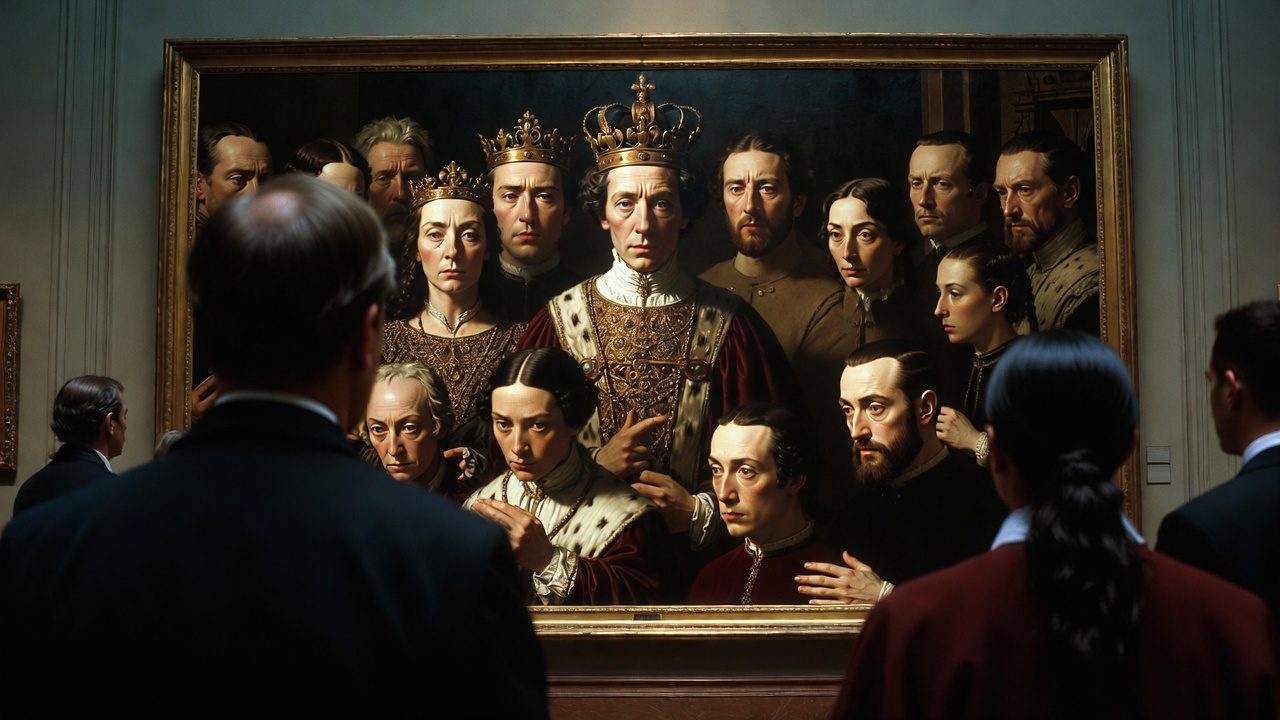
For centuries, art historians dismissed these flattened figures as technical slips. The assumption was that masters focused all their skill on paying clients, leaving background characters to apprentices or rushing to meet deadlines. Recent analysis of underdrawings and workshop records proves this wrong. The unfinished look is a deliberate choice, baked into the composition from the first sketch.
Код визуальной иерархии
Medieval and Renaissance Europe operated on a rigid social hierarchy that art was expected to mirror. A king’s right to rule, a saint’s connection to the divine, a donor’s piety — all were signaled through visual detail. The more elevated a figure’s status, the more time the artist spent on their features, clothing, and posture. Secondary characters, by contrast, were meant to recede. They were not individuals, but props to frame the main subject.
Surviving workshop contracts from 15th-century Italy show tiered payment structures for different figures in a single composition. Central religious figures or paying patrons commanded the highest fees, secondary saints or family members lower rates, and unnamed background characters the smallest sums. Artists allocated time to match these payments. A central figure might take weeks of work, with multiple revisions to capture a likeness. A background servant might take an hour, with no expectation of individual detail.
This visual hierarchy mirrored social reality. In Renaissance cities, servants and laborers had no legal standing to own property, testify in court, or move freely without permission. They were seen as extensions of their masters, not independent people. Rendering them with the same detail as a king or saint would have been a visual contradiction, implying they held equal status. The unfinished look was a code understood by every viewer of the time.
15th-century art theorist Leon Battista Alberti laid out this principle explicitly in his 1435 treatise On Painting. He advised artists to arrange figures by their social and moral rank, giving the most light, space, and detail to the most worthy subjects. Secondary figures should be painted with less precision, he wrote, so they do not distract the viewer’s eye from the main action. For Alberti, this was not a shortcut, but a rule of composition tied to the order of the world.
The same pattern appears in Northern Renaissance art. Hans Memling, a leading painter in 15th-century Bruges, often included servants in his donor portraits. In his 1480 Portrait of a Man with a Servant, the wealthy merchant is painted with individual stubble, a textured velvet doublet, and a sharp gaze. The servant standing behind him holds a glove, but his face is a featureless pink oval. His hands are two merged shapes, with no visible knuckles or nails. Memling’s anatomical skill was undisputed — he painted detailed, realistic portraits of merchants and nobles across Europe.
Символизм пустоты
Look at Domenico Ghirlandaio’s 1486 fresco Birth of the Virgin in Florence’s Santa Maria Novella. The central figure, the infant Mary, is surrounded by women with finely braided hair, embroidered gowns, and distinct facial expressions. Two servants stand near the back, holding towels and basins. Their faces are smooth ovals with no defined noses or mouths. Their hands are vague shapes, lacking individual fingers. This is not a lapse in skill — Ghirlandaio was renowned for his precise portraiture of wealthy patrons.
Exceptions to this rule prove the deliberate nature of the practice. When a secondary figure has distinct features, it is almost always a specific, named person. A servant with a clear face might be a younger son of the patron, included in the painting to secure his place in the family’s legacy. A laborer with defined hands might be a local saint, painted into a scene to claim the area’s spiritual protection. The lack of detail is reserved for the truly anonymous.
Workshop notes from the period show that artists intentionally used simplified features to signal social rank. A servant’s featureless face was not a mistake, but a visual shorthand for their lack of individual agency in law and custom. The flattened features also carried symbolic weight for contemporary viewers. A servant with no defined face represented the total absorption of the self into service. Without individual features, the figure could stand for any servant, anywhere — a universal symbol of low status.
Underdrawings, the initial sketches artists made on prepared wood panels or canvas, show that secondary figures were planned as simplified shapes from the start. There are no erased details, no signs of a face being scraped away. The servant’s featureless oval was drawn first, then painted exactly as sketched. Apprentices might handle these background figures, but only following the master’s explicit instructions.
Critics sometimes attribute merged fingers or stiff postures to a lack of anatomical knowledge. This ignores the fact that the same artists painted detailed, accurate hands for central figures. A king’s hand might show individual veins, calluses from riding, and a signet ring with precise engraving. The same artist would paint a servant’s hand as a single pale shape, with no individual digits. The difference is not skill, but intent.
| Attribute | Central figure | Secondary figure |
|---|---|---|
| Detail level | High, individual features | Low, generic features |
| Time spent | Weeks to months | Hours to days |
| Payment tier | Highest in contract | Lowest in contract |
| Symbolic meaning | Individual status, piety | Anonymous service, low rank |
Modern viewers often miss this visual code. We live in a society that values individual equality, so a featureless face reads as a mistake, not a signal. When we look at a 15th-century painting, we expect every figure to have the same level of detail, because we assume every person has equal worth. For contemporary viewers, the difference in detail was as clear as a modern uniform: a servant’s simplified form told you exactly who they were, no further explanation needed.
Look at any large Crucifixion scene from the 16th century. Jesus on the cross is painted with individual wounds, a slumped posture that conveys weight, and a face contorted in pain. The Roman soldiers gambling at the foot of the cross have smooth, expressionless faces, merged hands, and stiff poses. Their simplified forms frame the central religious event without pulling the viewer’s attention away. This was not an artistic failure, but a success.
Every simplified face and merged hand was a clear statement of place and rank for contemporary viewers. The old masters did not make mistakes — they painted the world exactly as they saw it, and as their patrons demanded it be shown.