
⌂ → Об искусствеСтеклянная печаль: почему слёзы на картинах никогда не высыхают и не текут, как вода
Look at a 17th-century portrait of a weeping penitent. The tear perched on her lower eyelid is a perfect, translucent sphere, glowing like a tiny glass bead. It never slides down her cheek, never leaves a damp streak on her skin, never dries to a salt crust. Real tears — warm, salty, fast-moving — leave no permanent mark on canvas. They spread across skin in seconds, leaving shiny trails that fade as they evaporate.
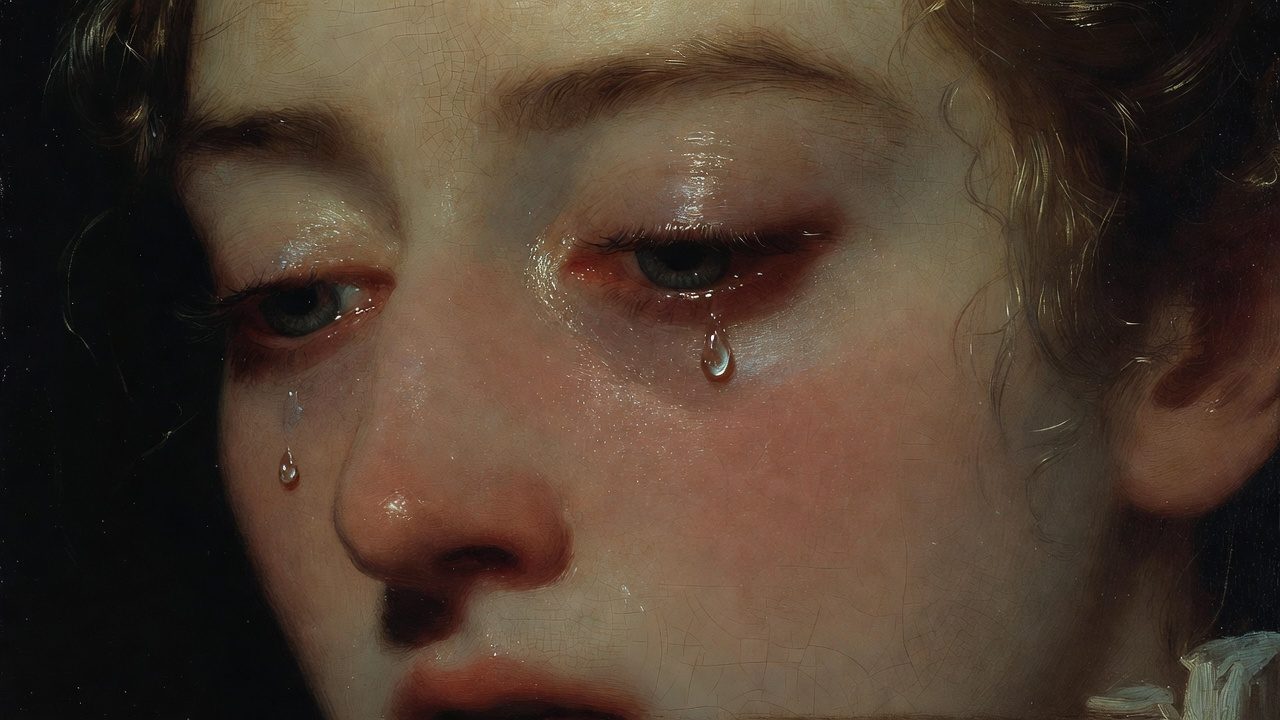
For centuries, painters have flattened the messy, fluid reality of weeping into frozen, gem-like shapes. A tear on canvas is rarely a streak of wet paint. It is a solid, rounded form, outlined in white or pale blue, sitting static on the sitter’s face. This choice is not accidental, nor is it a failure of skill.
Технические ограничения масляной живописи
Oil paint, the dominant medium for Western art from the 15th to mid-20th centuries, has specific limitations. It dries through oxidation, not evaporation, so thin, transparent layers take weeks to set. Trying to paint a thin, moving streak of water requires mixing white paint with a medium to thin it, but salt water leaves crystalline residue as it dries — a detail oil cannot mimic easily.
Restoring 16th-century portraits reveals layers of paint used to build tear shapes. Conservators often find 3–4 thin layers of lead white under a single tear, creating a raised, solid form. Thin, streaking layers would show cracks or uneven fading over centuries, but static tears remain intact.
| Параметр | Реальная слеза | Слеза на картине |
|---|---|---|
| Состояние вещества | Жидкость, течёт под действием силы тяжести | Твёрдый застывший объект |
| Форма | Неправильная, растекается по поверхности | Сферическая, чёткие края |
| След на коже | Влажный след, солевые разводы после высыхания | Отсутствует |
| Символическая нагрузка | Физиологическая реакция на боль или радость | Духовная скорбь, чистота намерений |
Символизм драгоценного камня
Medieval and Renaissance artists rarely aimed to paint the physical world as it appeared. Their work prioritized spiritual truth over literal accuracy. A tear was not a bodily fluid to them — it was a symbol of purity, penitence, or divine grace. Shaping it like a pearl or a crystal reinforced that meaning. Pearls were rare, expensive, associated with the Virgin Mary in Christian iconography.
A tear shaped like a gem implied value, not mess. If a painter rendered a wet, dripping streak, the sitter would look dishevelled, their grief too raw, too human. For portraits of saints or nobles, that undermined the intended mood. The tear had to be perfect, untouchable, removed from the mess of daily life.
Страх перед несовершенством
Patrons often commissioned portraits to project a specific image. A noblewoman weeping for a lost husband wanted to look dignified, not red-nosed and blotchy. A saint weeping for humanity’s sins needed to look holy, not like someone with a bad cold. Painters catered to these demands by sanitizing grief, removing all traces of its physical mess.
«Заказчики платили за идеализированный образ, а не за документальную съёмку», — говорит искусствовед Анна Лебедева, куратор выставки «Тело и эмоции в европейской живописи XVI–XVIII веков». «Любая деталь, напоминающая о физиологии — пот, слёзы, выделения из носа — считалась неприличной, если только речь не шла о сценах мученичества, где грязь оттеняла страдания».
Even in scenes of extreme grief, tears stay static. Look at Caravaggio’s “The Entombment of Christ” — the weeping Mary has no streaks on her cheeks. Her tears are small, round, pale smudges near her eyes, barely visible. Caravaggio was known for realism, but even he avoided painting flowing tears. The risk of ruining the composition with a muddy streak was too high.
Some artists found workarounds. They used tiny dots of lead white paint to create the illusion of a tear, building up layers to make it look raised. Others mixed in a touch of blue pigment to mimic the refractive quality of water, without actually painting a liquid streak. These tricks worked because viewers expected tears to look like gems, not water.
Watercolour painters faced similar issues, though the medium dries faster. Even so, tears in watercolour works are usually small, round dots, not streaks. The pigment settles into the paper’s texture, creating a static shape that never blurs.
This gap between reality and art persists even today. Contemporary painters still use static, rounded tears in figurative work, following centuries of visual tradition.